Comparing white and black truffles — is always about a bit more than just culinary arts. It is an attempt to understand the nature of their complex appeal, to feel the difference between a foggy morning in the forests of Alba and the scent of damp humus under the dense oaks of Périgord. In this article, we have gathered all our experience — from talking with customs officers on sub-Balkan roads to evenings with chefs in cozy Odesa restaurants — to lay out absolutely everything about the two main truffle worlds: white (Tuber magnatum pico) and black (Tuber melanosporum).
Visible and Biological Differences
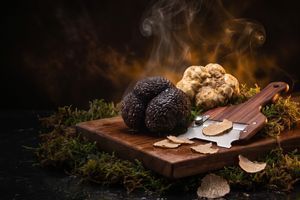
The very first moment you see these two truffles side by side, you realize — these are different stories. The white truffle (the most valuable in the world — the famous alba) has a light appearance, with a creamy or straw-colored skin, occasionally featuring reddish-brown spots. Its curves are always somewhat random — as if it has repeatedly bumped into stones underground while growing among the roots of poplar, oak, or hazel. The internal structure resembles marble: the flesh shimmers with white veins on a creamy or pale pink background.
The black winter truffle (or Périgord) is completely different — the skin is dark, almost black, with a warty and in some places pyramidal texture that resembles a stone weathered by time and rain. Inside — deeply black flesh with a lace of fine white veins, which, unlike the white truffle, always remain white and do not change color as the fruiting body ages.

The regions where these gifts of the forest are born also differ radically. The white truffle grows only in a few corners of Europe: most vividly — in Piedmont (surroundings of Alba, Langhe), slightly less — in Umbria, Tuscany, France (Vaucluse, Drôme departments), and also in the Balkans. The black one has a wider habitat: France (Périgord, Burgundy), Italy (Umbria, Piedmont, Marche), Spain, Croatia — and even new plantations in Australia, New Zealand, and the USA.
The white truffle is extremely demanding of its companion tree — it vitally depends on a symbiosis with poplar, willow, hazel, linden, or oak. And it is exactly this narrow range of partners that makes its mass cultivation impossible: attempts to cultivate it are still more of a scientific project than a real alternative to wild forests. In contrast, the black truffle demonstrates greater «flexibility» — it befriends various types of oaks, hazel, and even cherry trees, which is why people have successfully learned to grow it on special truffle plantations.
Aroma and Taste: Light and Dark Facets of the Truffle Palette
The main magic of a truffle lies in its aroma. But, just like night and day, white and black truffles smell completely differently. The white truffle — has an explosive, almost rebellious aroma: sharp, garlicky, with notes of cheese, alcohol, undergrowth, and sometimes — even a slight hint of petroleum, which eventually dissipates in the air. If you take a white truffle out of its box, your kitchen will instantly be filled with the scent of damp earth, mushrooms, and autumn trees.
Scientists count up to 120 aromatic compounds in the white truffle. The key one (bis(methylthio)methane) provides that characteristic «garlicky» trail, which is unlike any other mushroom or spice in the world.

The black truffle — is different in everything: its aroma is more muted but complex. It is the scent of damp soil, leaves, and undergrowth with exquisite notes of chocolate, hazelnut, sometimes — black radish and dried fruits. Here there is more umami, earthiness, and a long aftertaste without the «wild intensity» of the white one. And most importantly: the black truffle doesn't just smell — it has an expressive, deep taste, which remains even after delicate heat treatment.
Heat as a Chance and a Threat: Principles of Kitchen Use
The two major mistakes of all culinary beginners – boiling a white truffle in a cream sauce (and forever losing all its aromas), or sprinkling an already finished pasta with a black one, never revealing its true flavor potential.
The white truffle absolutely cannot tolerate any heat treatment! Its aromatic compounds evaporate even at room temperature. The correct approach: shave the thinnest «petals» using a truffle slicer immediately before serving, so the warm air of the dish catches the aroma and carries it to the gourmet. It is this exact moment that creates a feeling of luxury — even with just 5-10 grams of the product.
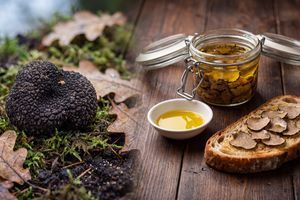
The black truffle, on the contrary, knows how to reveal its character during delicate heating. Its persistent aromatic compounds withstand temperature, making it ideal for creating truffle oil, truffle butter, fondue, pâtés, or frittatas. The main rule — is to add it to dishes at the very end of cooking or gently warm it in fats (butter, cream), avoiding overheating.
Quick Comparison Table for Convenience
| Characteristic | White Truffle (Tuber Magnatum) | Black Winter Truffle (Tuber Melanosporum) |
|---|---|---|
| Appearance | Creamy, smooth, spotted | Dark, warty, lobed |
| Interior | Light with white veins | Dark with distinct white veins |
| Aroma | Very intense, garlicky, cheesy | Earthy, nutty, chocolatey |
| Taste | Barely pronounced, more aroma than taste | Persistent, complex, rich in umami |
| Heat treatment | Strictly no heating | Slight heating is allowed and enhances flavor |
| Season | October – December | December – March |
| Source | Wild-harvested only (forest) | Mostly cultivated (special plantations) |
| Price | High (on average 5 times more expensive than black) | High, but significantly more affordable |
| Storage | 5-7 days, cold, daily napkin change | 10-12 days, freezing is allowed |
| Best dishes | Pasta, eggs, risotto, parmesan cheese | Butters, pâtés, fondue, meat, complex sauces |
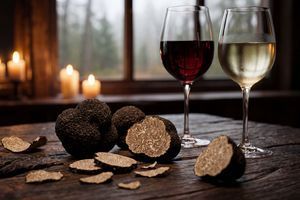
| Wine pairing | Barolo, Barbaresco, aged Chardonnay | Sangiovese, Vintage Montepulciano, Franciacorta |
Season, Availability, and Price
White truffles — are the most seasonal ingredient in haute cuisine. They can only be harvested in late autumn, and even then it is — a real lottery for the truffle hunter and his faithful Lagotto Romagnolo dog. That is why the price of a white truffle on the global market can reach €3000-4000 per kilogram, and by January only a few tubers remain for special orders from the most demanding restaurants. The black truffle is also seasonal but more accessible — it has a plantation alternative, which makes its price less «astronomical» and much more stable.
It is also worth remembering other subspecies of the black mushroom: for example, the summer black (Tuber aestivum) or the Burgundy (Tuber uncinatum). They have a milder aroma, a more delicate taste, and cost 3-4 times less than the winter standard.
Tartufi.ua Tips on Selection and Storage
When looking for a true white truffle, you should evaluate not only its size and weight but also the firmness of the flesh, the intensity of the «right» aroma (without mustiness or an overly damp hint), and the integrity of the skin. The black truffle is more tolerant of slight external defects, but it also loves care — daily maintenance and the strict temperature of a refrigerator.
Both types of truffles must be stored wrapped in a dry paper napkin, placed in a glass jar with an airtight lid, on the bottom shelf of the refrigerator. The main rule: every day — a fresh napkin (to avoid condensation buildup). By the way, a lifehack from chefs: you can store raw chicken eggs in the same jar. The shell has a porous structure and perfectly «absorbs» the aroma, so even simple scrambled eggs will acquire luxurious truffle notes by the second or third day.

Inspiring Culinary Combinations
The white truffle — is the undisputed king of pasta, eggs, and light parmesan. Just hot tagliatelle pasta with high-quality butter, a few fresh petals of white truffle — and you are already mentally somewhere in Piedmont under the first snow. Risotto Parmigiano also «sounds» perfectly with the white variety, as does tender meat carpaccio or fondue with cream cheeses. In these dishes, simplicity supports elegance, without overpowering the central aroma of the mushroom.
The black truffle — is the best friend of sauces, pâtés, fondue, truffle oil, and butter, as well as dishes with red meat and wild mushrooms. It gives that exact depth of flavor and long aftertaste, which is especially valued in steaks, game, or rich winter recipes. Perfect wine pairings for it — Italian Sangiovese, Montepulciano, full-bodied white wines, and even sparkling wines if cheese or champignons are prominent in the dish.

Instead of a Conclusion
White or black truffle? The answer always depends on the moment. If you are looking for a pure, emotional experience of aroma — definitely choose white. If you want to make a Sunday family dinner truly special — take the black truffle, as it boldly gives room for culinary imagination and allows you to experiment. We at Tartufi.ua are always happy to help you feel this subtle difference and find exactly the truffle that will become your new unforgettable gastronomic story — from the morning forests of Italian Alba straight to your evening kitchen.